In this conversation, Hot Sheet sits down with artist Amy Hui Li to explore her artistic practice, creative influences, and the ways in which memory, emotion and personal experience shape her work.
Through an exploration of the relationship between the physical and emotional, Amy's practice considers how fleeting moments, sensory experiences and fragments of the past can be translated into visual form. Her work reflects on the deeply personal yet universal nature of memory, examining how sounds, scents and images can transport us back to moments we thought we had forgotten.
Ahead of her presentation at Minor Attractions 2026, we discuss her work heartbeat recreated, a reflection on the fragile and often unpredictable ways we reconnect with our past. Moving between remembrance, loss and renewal, the work considers how memories can be brought back to life through the senses, allowing us to momentarily revisit the emotions and experiences that have shaped us.
Our conversation also touches on Amy's creative journey, her artistic influences, and her perspective on the contemporary art scene in China, offering a deeper insight into the ideas and experiences that continue to inform her evolving practice.
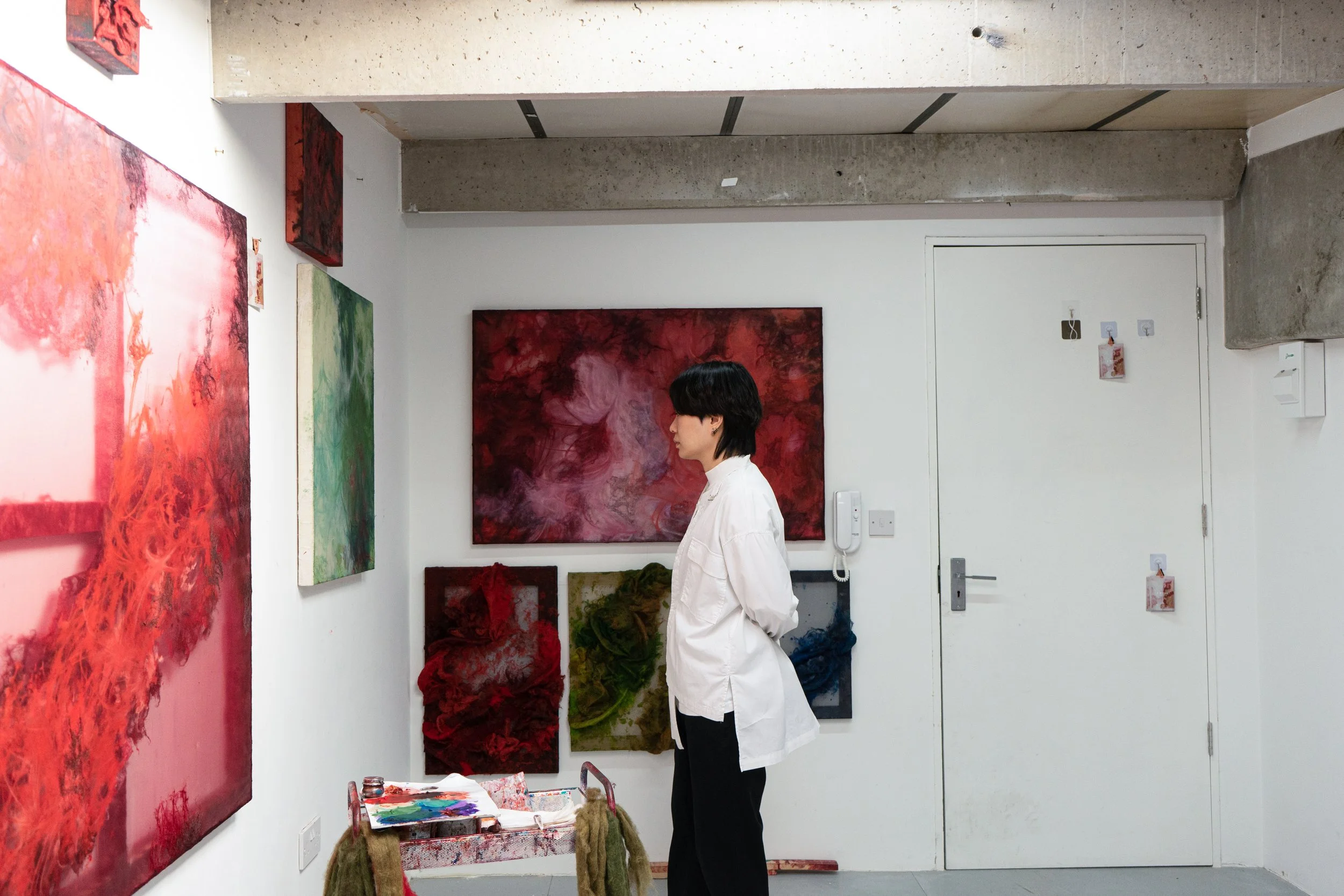
We would love to know how your practice began, and what first drew you towards working between painting and textiles?
My family owns an office furniture company, and I remember spending time browsing different leather, fabric and cotton swatches when I was little. I was fascinated by the variety of textiles and enjoyed touching them, feeling their different textures on both sides. Looking back, I think this early sensory experience planted the seeds of my interest in materials.
Later, while living in Guangzhou, I became involved in a branding business with friends and collaborated on a T-shirt project. Guangzhou is home to Zhongda Fabric Market, one of Southern China’s major textile and apparel accessories wholesale hubs. We sourced textile samples and learned about the process of making T-shirts, which gave me a closer understanding of fabrics beyond their appearance, including their textures, qualities and potential uses.
Although I had always been certain of my love for painting and colour, it was not until I joined the Graduate Diploma in Art & Design at the RCA in 2022, a year before beginning my MA in Painting in 2023, that I started bringing elements of fashion and textiles onto the painting frame. I began to question the conventions of painting and wondered: why not break the rules a little? Why should the front of a painting be the only side that matters? What might happen if I turned it around and allowed the back to be seen?
This simple question opened up a new direction in my practice, allowing my longstanding fascination with textiles to meet my interest in painting and gradually challenging my understanding of what a painting could be.
So lovely to hear about your early experiences with different fabrics and how this has informed your artistic practice. What is your relationship like now with the contemporary art scene in China? Are there conversations or developments happening there that feel particularly relevant to your practice?
This summer, I had the chance to spend some time back home with my family in Guangzhou. The weather was hot. The two things I did that were connected to art were visiting the Baietan Art Centre, a new venue of the Guangdong Museum of Art that opened in 2024 and which I had not visited before, and seeing the 2026 MFA degree show at the Guangzhou Academy of Fine Arts.
Having studied in London for so many years, beginning with my BA in Fine Art at Goldsmiths, I realise that the development of my practice is naturally rooted in my experiences here, alongside the years I have spent living in China. I do not necessarily see a direct connection between my work and Chinese society, nor do I feel the need to make that relationship explicit. However, I recognise that both cultures have shaped the person I am and, in turn, the artist I have become. Perhaps these influences do not always appear directly in my work, but exist more subtly in the way I think, feel and understand the world around me. Rather than trying to define my practice through either cultural context, I am interested in how these experiences coexist within me, becoming part of my perspective and finding their way into my work in ways I may not always be conscious of.
That makes sense. Similarly, since your studies at the RCA, how has your practice developed?
Looking back at my practice at the RCA three years ago, I was primarily focused on expanding my sculptural painting by pushing its physical limits, particularly in terms of scale. This was evident in my degree show work, soaked in stardust, which we exhibited together in 2024 alongside this piece. My practice was much more experimental at the time, exploring multilayered organza that could be torn apart, as well as oil paint on linen and canvas. I moved between works ranging from two metres to paintings as small as twelve centimetres. It was an exciting period of experimentation, and I remember how much fun I had exploring all these possibilities.
I used to think that my practice only truly began to evolve after leaving the RCA. During the following three years, I spent a great deal of time refining my material language, narrowing it down to three core elements: oil paint, coloured felt and organza. The challenge was to discover how much I could achieve with these materials, and how differently I could arrange and combine them to create new work.
Gradually, I began to explore different ways of layering and concealing the materials, placing felt on top of the organza or hiding it behind the translucent surface. I developed my own techniques, almost like little secrets, to secure the materials in place while preserving the qualities that drew me to them in the first place. Throughout this process, I have tried to ensure that each material does more than serve a practical purpose: it must also carry the emotions and express the intentions behind the painting.
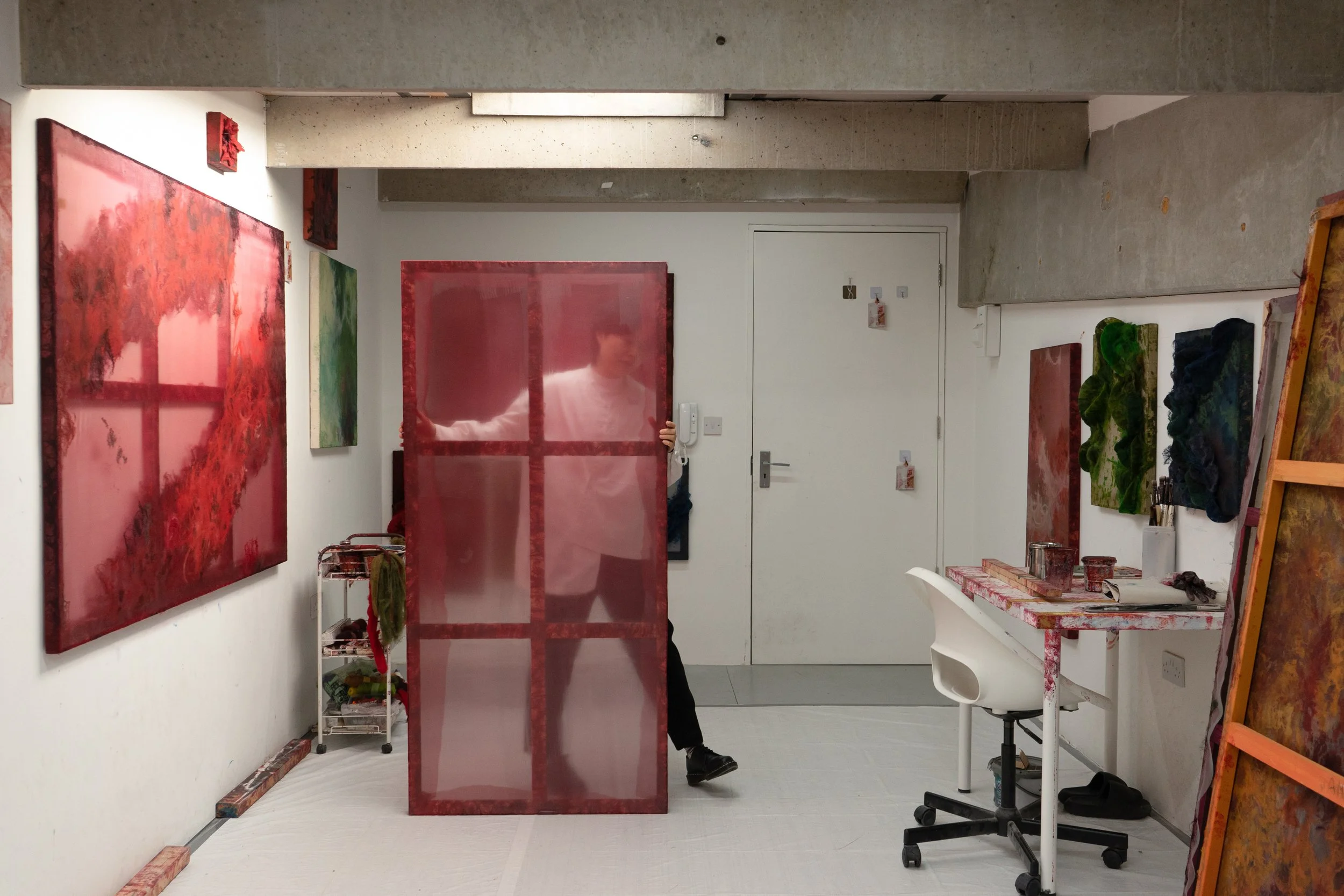
Your work has evolved since then for sure. Could you take us through how an artwork develops, from the first feeling or idea to the finished piece?
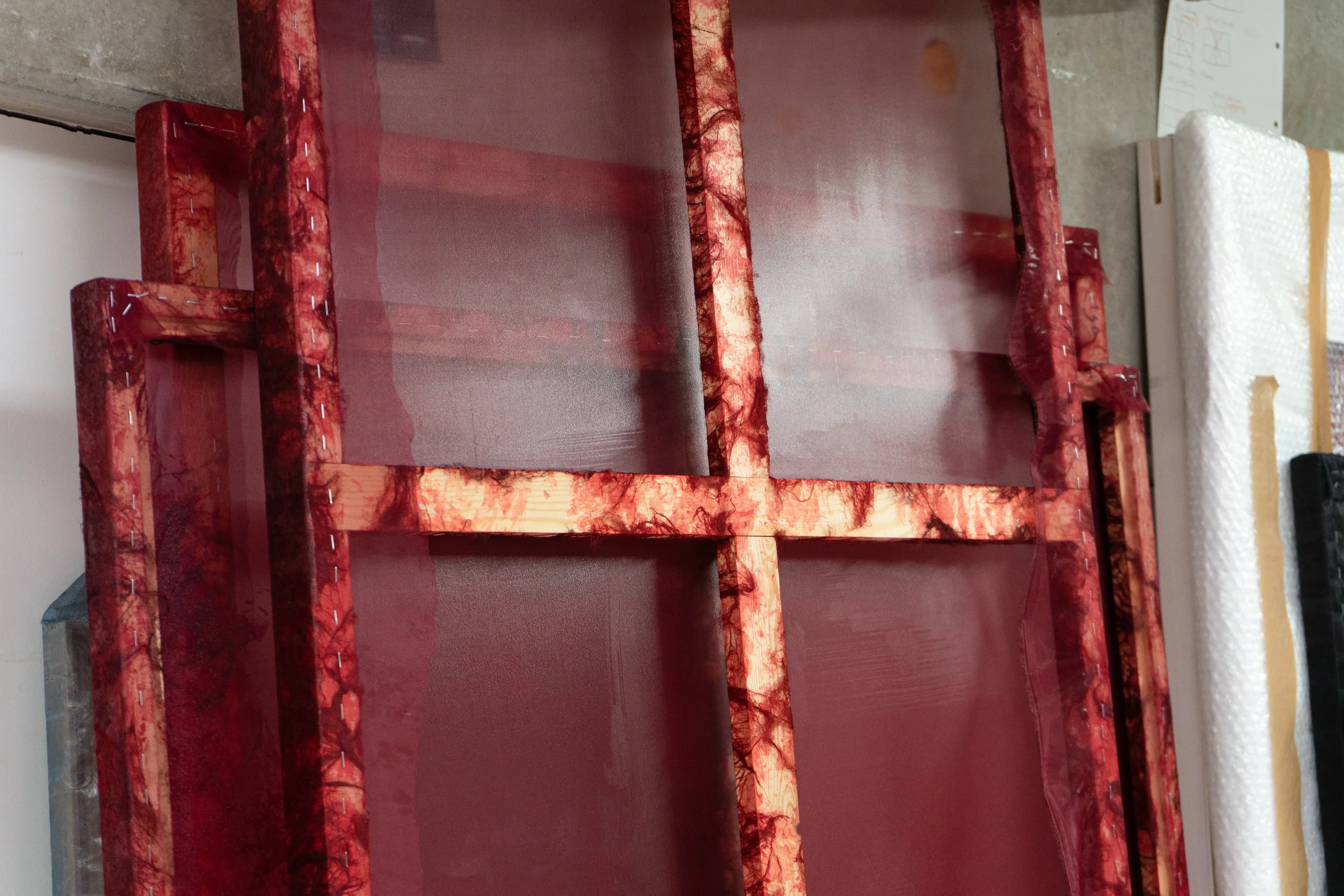
The process often begins with the stretcher frame, which sets the tone for the scale of the work. I like to collect stretcher frames from friends, as they bring an additional layer of history to each painting, a small, hidden story embedded within its structure. Once I have taken one in, I feel a sense of responsibility to transform it into a complete painting.
The transparency of sheer organza allows me to work on both sides of the frame. After stretching the fabric, I turn the frame over and begin working from the back. Sometimes I plan the composition in advance; other times, I follow my instincts and allow the process to unfold naturally.
I mix diluted homemade acrylic paint with glue to create my felt material, tearing it into small pieces and shaping it by hand. I usually begin by applying the felt to the back of the organza. Once it has dried, I turn the frame over and continue working from the front, adding further layers to the surface. I also peel pieces away and reapply them, allowing the material to be repeatedly altered, removed and reconstructed. Through this process, I gradually build up the foundation before introducing oil paint.
I enjoy the unexpected traces left behind by the materials throughout this process. Rather than seeking complete control over the outcome, I allow these marks, textures and imperfections to become part of the painting, creating a surface that holds the history of its own making.
It does feel like there is emotional depth that is captured in the imperfections, it really resonates.
What does working with felt and other alternative materials allow you to express that paint alone cannot?
There is something deeply satisfying about working with both hands, tearing and shaping the materials through touch. I enjoy the process of building things up, particularly the idea of individual threads coming together to form a stronger surface. There is a sense of care and transformation in this process that resonates with me.
In my practice, one hand reaches towards new possibilities, exploring new materials and the concept of Expanded Painting, while the other holds on to traditional techniques. I am interested in opening up the possibilities of painting beyond its conventional boundaries, continually searching for approaches and materials that feel true to my intentions.
Softness is something I seek within my work, and felt offers a material quality that speaks to this desire. Its texture and flexibility allow me to work in ways that feel intuitive and personal. At the same time, brushes and paint remain just as important as my method of tearing. Rather than choosing between traditional painting and more tactile processes, I allow them to coexist, each contributing something different to the language of my work.
It is good to find a balance in techniques. In a slightly different vein, how does personal memory enter your work? Do you begin with a particular experience, or does its meaning emerge through making?
Memories find their way into my practice in different ways. When I work with blue, I usually have a specific story or reference in mind that I want to revisit. I hold a fragment of that memory in my thoughts as I paint, allowing it to accompany me throughout the process. Music also plays an important role in this act of remembering. I often return to the songs I listened to during that period of my life, and sometimes their lyrics become the titles of my paintings, carrying a trace of the emotions and experiences attached to them.
My red paintings, on the other hand, always begin in the present moment. They respond to what is happening in my life as it unfolds, making each work an expression of a particular time and state of being. Rather than starting with a defined story, the narrative often develops alongside the painting itself. Through the process of making, the work and its story gradually take shape together.
For much of your work your use of colour has centred around key colours such as red and blue. It would be great to hear from you what you feel the role colour plays in your practice? How do you find the colours that feel right for a particular work?
I have always thought about colour in relation to time. Most of my work explores different shades of red, which I associate with anxiety, alertness, vigilance and exposure. Red feels like blood running beneath the skin, constantly moving. It is vulnerable, yet full of vitality and passion. To me, red speaks of the present moment, reminding me of the immediacy of being alive. It is perhaps the most direct expression of emotion, raw and impossible to ignore.
Every year, around springtime, I find myself returning to my blue series. Blue feels gentler; it speaks of memory and the past. When I look back, memories and stories are often filtered through time, leaving behind traces of bitterness and tenderness, softened by distance. Working with blue allows me to revisit these moments with a different kind of sensitivity.
Green, for instance, was inspired by Central Park in New York City, while white carries a message towards the future. These colours exist more like side stories within my practice, each holding its own associations with time and experience.
I find a sense of peace in working with a limited colour palette. It is important for me to feel deeply connected to my work, to be able to spend time with it and continue looking at it without losing that connection. Colour comes to me for a reason, often as an instinctive source of inspiration that I feel compelled to follow. A mixed palette can sometimes leave me feeling disordered and disconnected, as though the colours are speaking in too many voices at once. Perhaps, one day, my relationship with colour will evolve, and I will find a way to bring them together. For now, I am content to let each colour inhabit its own time and tell its own story.
So lovely to hear how the colours in your work also relate to the seasons as I feel our emotions are so intricately tied to the seasons sometimes that it naturally comes into your practice. You also know how much we love the green pieces so love that they are connected to Central Park! Tearing, reshaping and mending are part of your process. What happens to a piece through those actions, both materially and emotionally?
I suppose mending often functions as a metaphor within my practice. It is an act that responds to a problem: damage comes first, and mending follows. In my work, damage has only ever occurred by accident. Although it has happened a few times, I have never intentionally set out to damage a piece. Rather, mending, for me, refers to the act of stitching, repairing and gradually restoring a state of mind.
When comparing a physical wound to an emotional breakdown, I often feel that the body knows how to heal itself, while the mind can remain lost within its pain for much longer. Physical wounds may gradually close, but inner wounds are less visible and can be much harder to understand or overcome. Through my practice, I hope to work through these internal emotions in the studio, allowing the process of making to become an essential part of that journey.
Perhaps the act of mending is not about finding an immediate solution, but about giving myself the time and space to confront what I feel. The process itself can be difficult, but once a piece is finished, I often find a sense of happiness and satisfaction. In this way, making becomes more than the production of an artwork; it becomes a way of working through my emotions, making sense of them and finding a path towards healing.
Continuing on from that, what does repair mean to you? Is it about recovering something, accepting change, or creating something new?
Repair is, for me, a journey of overcoming difficulties, learning to grow and becoming stronger. It is something I aspire to in both my life and my artistic practice. The process of repair becomes a dialogue with myself, an opportunity to reflect, reconsider and discover. It asks me to decide what to hold on to and what to leave behind. Perhaps repair is not simply about returning something to its original state, but about accepting the changes that have taken place and allowing something new to emerge.
Your work is so personal, being tied so closely to your memory and emotions, when making work from personal experiences, how do you decide what to share and what to keep private?
I often feel exposed to the world, both as a person and through my work. Since the two are so deeply intertwined, working with sheer organza has become a way of revealing what lies beneath the surface, evoking the interior of the body and allowing vulnerability to become visible. In doing so, I am also challenging myself to be more honest in front of an audience.
Yet, I prefer to communicate these experiences through poetry rather than direct explanation.
This is something I continue to explore in my practice: how to express something deeply personal without revealing everything, leaving space for imagination and allowing the audience to find their own meanings within the work. This openness is important to me, as I believe that what remains unseen or unspoken can be just as meaningful as what is revealed.
Because my work is rooted in such personal experiences, the connection between the two has become increasingly intimate. At times, the boundary between myself and the work feels almost indistinguishable. I sometimes find myself questioning where one ends and the other begins, and whether it is possible to separate my own sense of self from what I create.
It makes sense, hard to entangle yourself from the artist and the personal life you experience, they are forever bound. Could you choose one recent work and tell us about a moment in its making that changed your understanding of it?
This year, I took a step back from being a full-time artist, and as a result, the growth of my practice has slowed. Navigating life outside the studio while trying to find the right balance between the external world and my studio routine has not been easy. I struggled.
As an artist, the way my mind works is that I am always pushing my limits, striving to do my best and giving everything I have to my practice. But when reality sets in, working a side job has taught me to take a step back and move one step at a time. The effort we put in does not always translate into the rewards we receive.
Living with these two mindsets pulling me in opposite directions has been a challenge. Yet, in September 2026, I finally finished a painting that I felt truly satisfied with. It felt like a significant breakthrough, a big step forward in my practice. I treasure this moment a lot, and I hope to keep up, moving forward and finding ways to sustain this momentum.
This experience has made me realise that art is truly a lifelong marathon. It takes time, and painting will continue. The challenge for me now is to learn to embrace the process, to be patient with myself, and to find joy in every part of the journey.
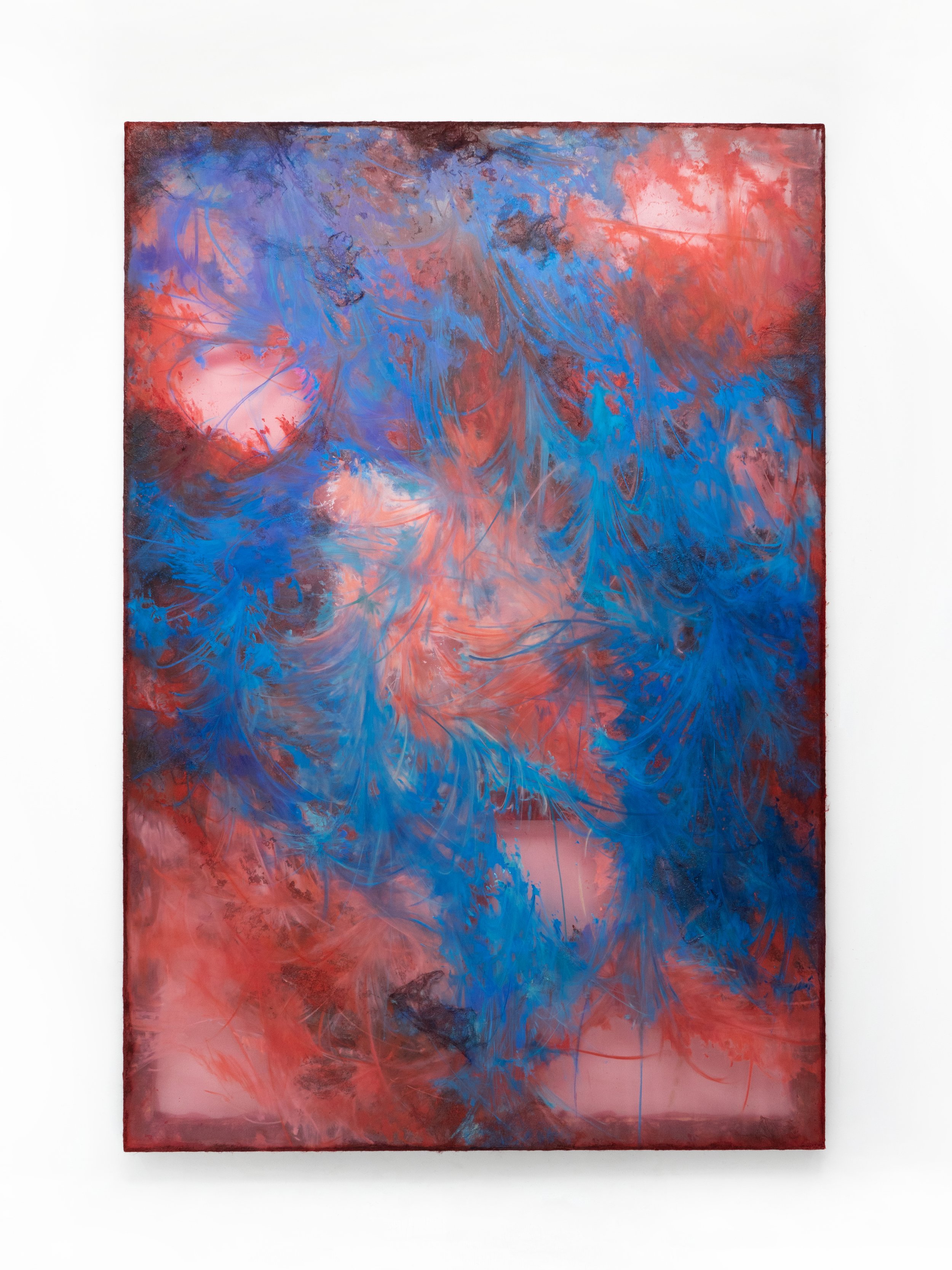
am i ocean, am i forest?
Oil and mixed media on organza
170 x 116 cm, 2026
Such a stunning piece!
Which artists, writers or experiences have most influenced the way you think about your practice?
I have always been drawn to the work and writing of Scottish artist Katie Paterson. Her ongoing work Ideas (2015–ongoing) has been a particularly profound source of inspiration for me. As she describes it, “A lifelong Series, the Ideas are artworks that may or may not come into being. These short haiku-like sentences take shape in the imagination of whoever reads the words and so become an expression of the idea itself.” Her work encourages me to think expansively and beyond conventional boundaries, bringing abstraction and imagination together through the careful choice of titles. It has made me reflect on how a few words can open up an entire world of possibilities.
British artist Celia Pym’s book On Mending has also influenced the way I think about repair, both in garments and in painting. The way she approaches damaged textiles resonates deeply with my own relationship to painting, particularly in how damage, care and the act of mending can become meaningful parts of a work’s material and emotional life.
I am also deeply drawn to Mark Rothko’s paintings. They have a calming effect on me, offering a sense of stillness whenever I spend time with them. I am inspired by his use of colour, and his work has encouraged me to trust my own colour choices and become more confident in my decisions as a painter.
Together, these artists have had the greatest influence on my practice, shaping the way I think about imagination, materiality, repair and colour.
Beyond visual art, what feeds your creative imagination, music, literature, film, or everyday encounters? Could you share an influence that has unexpectedly found its way into your work?
A day trip to the ocean, the forest or the beautiful countryside would always make my day, although the sea would be my first choice. :) I was born in July, and as a Cancer, I have always felt naturally drawn to water. I enjoy experiencing things physically and immersing myself in my surroundings. One of my simple pleasures is walking while listening to music, allowing myself to slow down and take everything in.
I also enjoy watching artist documentaries. Recently, I rewatched Sheila Hicks: We’re Crying for Softness on YouTube. I love listening to artists talk about their practices, experiences and personal stories, and finding inspiration in the ways they see and understand the world.
Music plays a big part in my daily life and creative inspiration. I often listen to English, Cantonese and Chinese, and I enjoy how each language and sound brings its own feelings, memories and atmosphere into my day.
In heartbeat recreated, shown at Minor Attractions, you describe how a song, a scent or an old painting can bring a forgotten moment back to life. How did you translate that sudden, physical experience of remembering into the work, and what does being “willing to fall down deeply again” mean to you?
I believe some memories are more significant than others. No matter how hard we try to remember everything, there will always be things we forget. I once visited an exhibition at the Serpentine Gallery three years ago. I remember loving it so much that I even wrote a blog post about it, yet I completely forgot about the experience until I came across a video I had taken at the time. Watching it allowed me to reconnect with that past experience and see the exhibition through a new perspective, while also reflecting on how I have evolved as a person. In a way, remembering what we once loved is an incredibly valuable experience.
I used to make paintings of perfume bottles because, to me, scent is like a canvas. Fragrances have the ability to capture and hold moments and memories, becoming associated with a particular period or stage of life. When I encounter them again in the future, they can bring me back to a specific time in my life. My old paintings hold a similar quality. Looking at them reminds me of my early days as an artist. The way I applied the paint, the environment I was working in, and the people I surrounded myself with all come together in the painting, preserving traces of who I was at that moment.
Music is, without a doubt, a significant part of both my life and my artistic practice. It is my emotional support, my therapy; I cannot imagine living without it. I once told a friend that, for the rest of my life, I wanted to immerse myself in nothing but music and creation. Let’s say I listen to a song more than 200 times in a month; this song becomes a record of those thirty days, holding the feelings, thoughts and experiences that accompanied me throughout that period. In this way, music becomes another form of memory, marking the passage of time through repetition and emotion.
For me, falling in love with something or someone means accepting the possibility that it may eventually bring pain. To fall deeply and willingly in love, then, is an act of courage: a willingness to embrace the unknown, knowing that we cannot predict where it will lead or how it might change us.
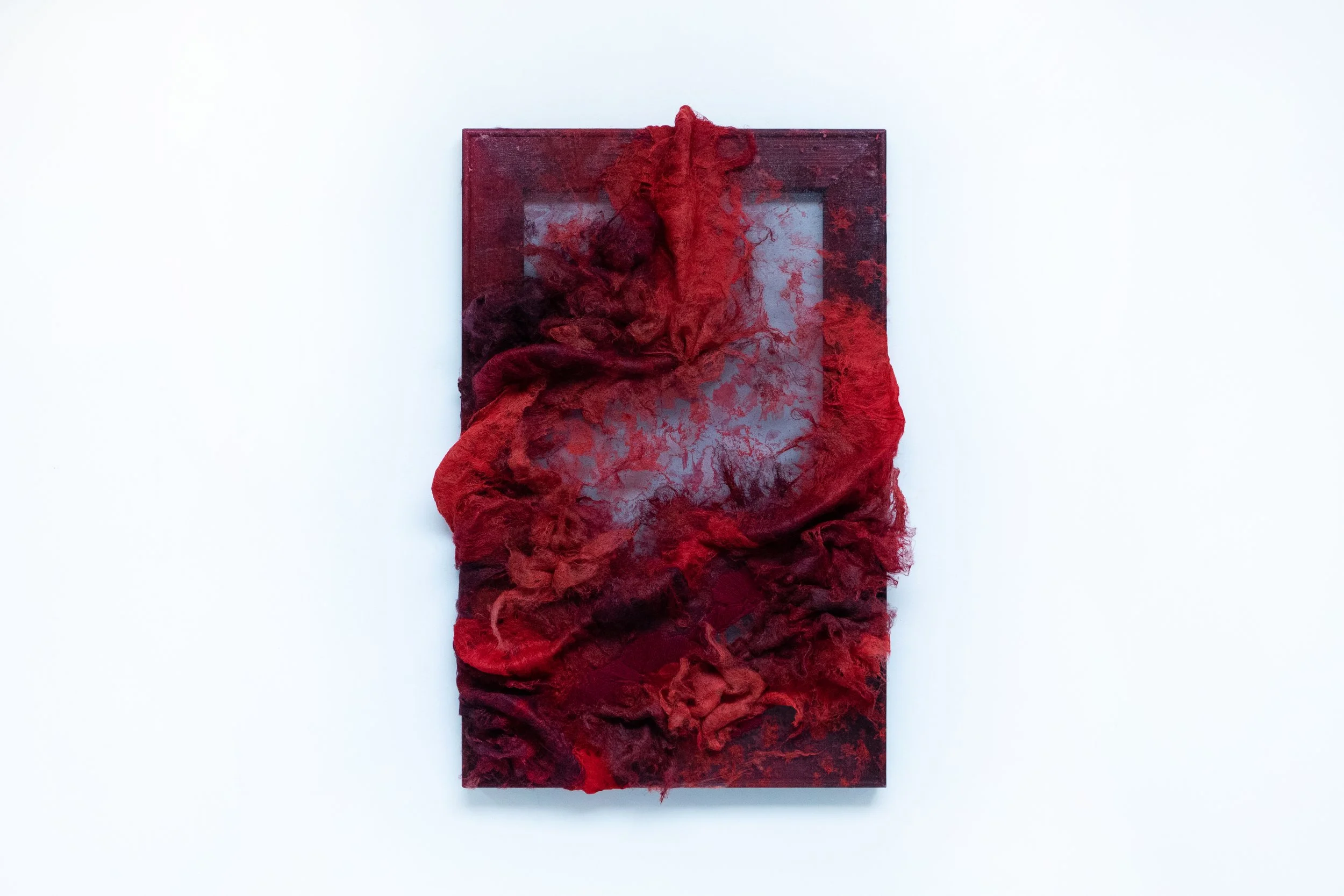
heartbeat recreated
Acrylic and mixed media on organza
70x45cm, 2025
It's so wonderful hearing about the work in your words and thank you for being so honest.
The room we are showing in for Minor Attractions is also on the theme of the past. What does this mean to you in relation to the piece and your practice in general?
The sculptural painting I am presenting is titled heartbeat recreated. It is part of my ongoing series ‘paradise lost’. The work explores the act of remembering what we once loved and cared for: reaching back into the past to reconnect with the memories that once made our hearts beat faster. It is a tribute to memories we once treasured, as well as an act of self-reflection. In this sense, the work naturally connects with the theme of the past.
I often find myself feeling nostalgic, looking back at who I used to be and criticising my past decisions. How could I have done better? How could I have improved? There is an ongoing dialogue between my present self and the person I once was, a process of looking back. I believe this way of thinking has unconsciously found its way into my artistic practice.
What are you exploring now, and what feels unresolved or open for you?
Over the past year, I have been exploring oil painting on organza. Although this approach shares similarities with my sculptural paintings, particularly in the materials and processes involved, it offers a very different way of working with the surface. In these oil paintings, I place felt material behind the organza, allowing it to be seen through the translucent fabric or revealed when the painting is turned over. What lies behind the surface becomes an essential part of the work, even when it remains partially concealed.
Both approaches belong to my ongoing series, although I am still exploring the balance between them and how they might develop alongside one another. At the moment, I find myself questioning how to take my sculptural paintings further. Perhaps they could move beyond the frame, become suspended sculptures or extend onto the floor. These ideas are still taking shape, and I am allowing myself the space to experiment without rushing towards a fixed outcome.
I can imagine my work evolving through custom-made frames and fabrics, opening up possibilities that respond to the materials and resonate with my artistic intentions. Finding ways to push the boundaries of my current practice, while remaining true to what draws me to these materials in the first place, will be my next challenge.
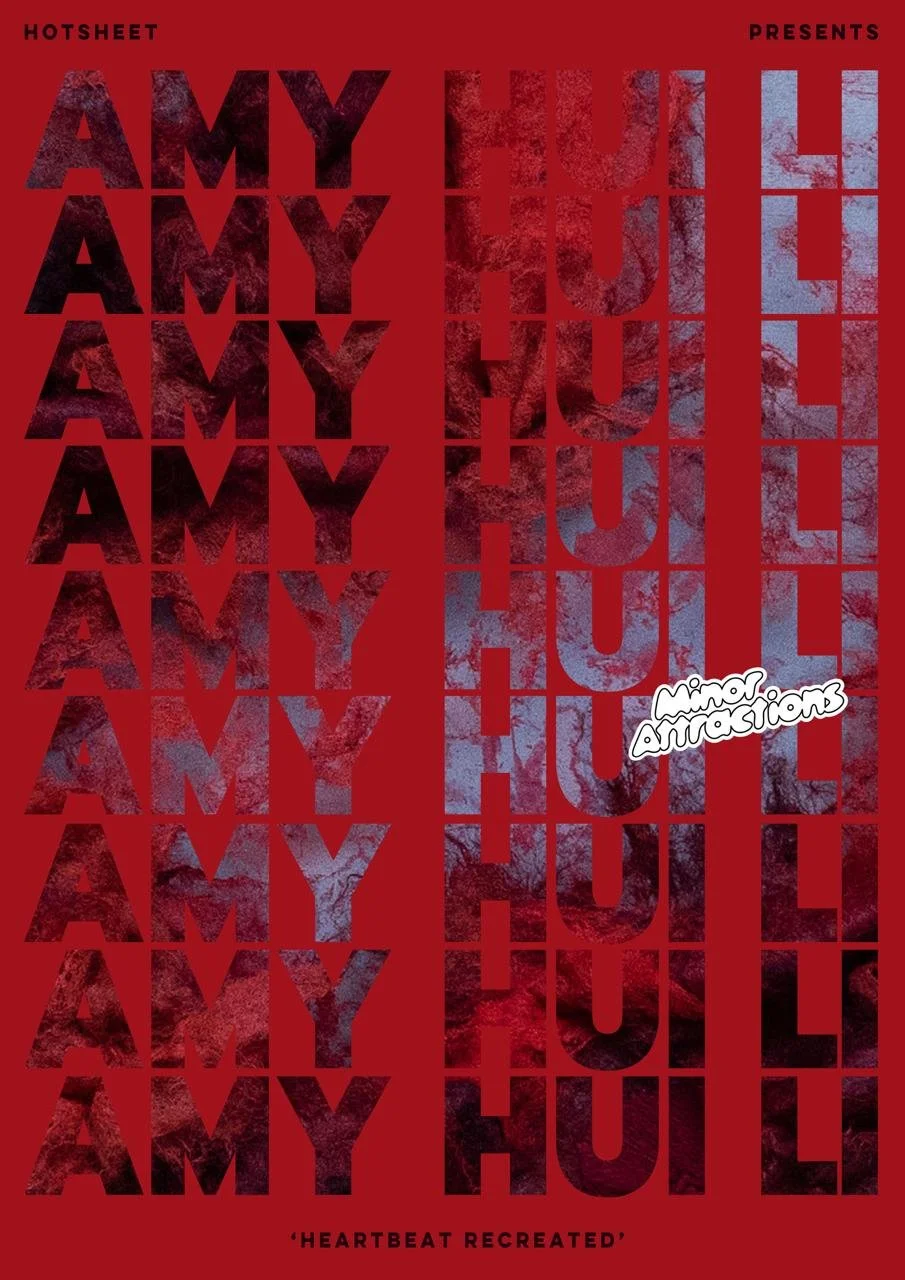
Minor Attractions opens the 13th October 2026 at The Newman Hotel with Hot Sheet